
Thursday, September 21, 2006

Who's next?

THESE are America's black billionaires. All two of them, according to Forbes magazine's annual list of the richest 400 Americans.

This year's list is all billionaires, meaning that for the first time, no one with fewer than 10 digits in the asset column qualified (and they say the rich aren't getting richer).

That only Oprah and Bob -- who needs last names or descriptors to know who they are -- are the only African-Americans in the Billionaire Boys and Girls Club is no surprise. He was the first to join in 2001 after he sold BET; she joined shortly thereafter and that, as they say, was that. For the record: Oprah tied with several other Billies at number 242 with an estimated $1.5 billion fortune, Bob and several others tied for 374th place with $1 billion even, proving, perhaps that it is lonely at the top but not necessarily so for middle of the road moguls.

But seriously, the perpetuity of Oprah and Bob on Forbes list begs a few questions, like when will black billionaires three, four, five or ten join them on the list and where will their money come from? A good percentage of the other Forbes-listers inherited their money, while the others made their fortunes on everything from oil to tech to sports. The lone two African-Americans on the list are self-made media entrepreneurs -- after all, nobody's black daddy until Bob had a billion to leave behind . Will the same hold true for the next to join the list, or will, say, a black investment banker or tech entrepreneur beat the next black media baron to the punch?

And perhaps the better question is when will someone take on the task of ranking the wealthiest African-Americans in the country? (If any of my editors are reading, I'm waiting for your call on this one.) One thing's for sure: we already know who will come in and first and second on that list.

Friday, September 15, 2006

Part 2: 'Brokest' it is

I've finished comparing Black Enterprise's list of the top 10 cities for African-Americans with A.G. Edwards' "Nest Egg Index", which ranks cities where residents are doing better at building wealth against those where they aren't.

Only one city on the Black Enterprise list, Washington, D.C., was also in A.G. Edwards' top ten. It came in at number eight. The only other top black city in the top 100 on the nest egg list was Baltimore, at number 60 -- and those two cities are so close that they're really part of one big metro area. Atlanta, Black Enterprise's number one city for black folks, ranked 123d on the nest egg ranking.

It's hard to say definitively what this all means, but there are a few ways to look at it.

Black folks have smaller incomes, fewer assets, and lower rates of homeownership, on average than whites. So it follows that 'blacker' cities would not fare well in a comparison based on A.G. Edwards' criteria, which factored in a dozen variables -- from income, to home values, to homeownership rates, debt and investment trends .

Many of the cities that scored higher on the A.G. Edwards list did so for reasons that could make them bad places for a young person of any race to try to build a nest egg, and the opposite is true for lower-ranked cities.

Boston, for example, ranked 13th on the list, despite its enormous cost of living and overblown housing market. By A.G. Edwards' standards, higher home values boosted a city's nest egg standing. But Boston would be less attractive to anyone trying to get his or her financial sea legs, while Atlanta, who's lower home values hurt it in the nest-egg rankings, would be much more attractive.

However you slice it, here's what the data showed:

City-- Black Enterprise Rank-- A.G. Edwards "nest egg" rank

Atlanta --1 -- 123


Washington, D.C. -- 2 -- 8

Dallas -- 3 -- 343

Nashville -- 4 -- 303

Houston -- 5 -- 455

Charlotte -- 6 -- 173

Birmingham, Ala. -- 7 -- unranked

Memphis -- 8 -- unranked

Columbus, Ohio -- 9 -- 238

Baltimore -- 10 -- 60


Sources: A.G. Edwards; Blackenterprise.com

Thursday, September 14, 2006

Required Reading, September '06

Heart & Soul magazine, where yours truly is a contributing editor, ran part two of a series called Livin' Large on a Tiny Budget in its August/September issue. I wrote part one, which ran earlier this year.

Essence's Work & Wealth section follows up on its homeownership series, gives tips on raising your credit score and profiles Marsha E. Simms, the first black female partner at New York law firm Weil, Gotshal & Magnes LLP, in its September issue.

Black Enterprise lists the top 50 colleges for African-Americans, names its black executive of the year and leads with a cover story on black supermodels-turned-entrepreneurs in its September issue.

Vibe Vixen advice queen Beverly Smith counsels a 26 year-old reader on getting ready to get a mortgage, in its Fall 2006 issue.

Wednesday, September 13, 2006

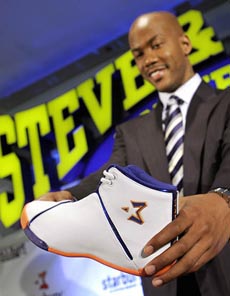
Would you rock these?


Would your kid? Would you buy them if you knew they were endorsed by the N.Y. Knicks' Stephon Marbury? Ok? Well how about if they only cost $15? You heard right. A black pro athlete with a shoe deal -- who's only charging 15 bucks for the sneakers.
Shrewd business move, or image killer? Who knows. Black kids since the Jordan era have typically shunned cheap sneaks. Marbury could be about to take a big loss here. Or, he could be onto something, or just out to make the point that there are more important things in life than shoes that cost more cash than you've got in your bank account. It'll be interesting to see how this one turns out.

Monday, September 11, 2006

Top 10: Best or Brokest, Part One

I wrote recently about an annual survey by A.G. Edwards, the money management firm, which ranks the best and worst cities in the country for building a nest egg. A.G. & crew looked at 12 factors, from the rate of homeownership, to income levels, debt levels, home values, the percentage of a city's population that are investors and the percentage that at least owned savings accounts. Looking at the criteria itself, it was tough to tell whether they wanted to show the best areas to start building a nest egg, or where people already had a good head start at doing so.

Of course, this also got me thinking about whether A.G. Edwards' data could tell us anything else, namely, where black folks stand a better chance of gaining some financial ground, or at least the cities where we're already doing OK.

No, said Sophie Beckmann, financial planning specialist for the firm. A.G. Edwards didn't collect demographic data at all. Fair enough. Still, in her own words, the city-by-city rankings are important because they show where in the country people are getting ahead and where it might be tougher to do so -- important factors in an era when employers and the government are doing less and less to ensure smooth sailing into retirement.

So with that in mind, I'm planning a little experiment. In the next day or so, I'm going to compare A.G. Edwards' list to Black Enterprise's most recent list of the Top 10 cities for African-Americans to see whether the best cities for black folks to live are among the best -- or worst -- places in the country for building a nest egg. I hope to have this wrapped up soon so you can see the results.

Tuesday, August 22, 2006

Minority Rules

I'm reading a new book, "Minority Rules: Turn Your Ethnicity Into a Competitive Advantage", written by Kenneth Arroyo Roldan, the top dog at Wesley, Brown & Bartle, an executive headhunting firm that specializes in finding minority candidates for gigs in corporate America. Like others before it (see Cora Daniels' Black Power Inc.), Roldan's book is all about decoding the corporate labyrinth and unlocking the translucent barriers to success that minorities face as we climb the management ladder. I'm not far enough along in the book to critique Roldan's writing one way or the other, but I do have some context I'd like to lend to his subject.

In most cases I'd be quick to point out the difference between income -- what you bring in each week from a job -- and wealth or net worth -- cash or assets you own regardless of your employment status. But in this case, I think there's an important link between the two. Roldan's advice could be critical to helping more young African-Americans generate some real assets of their own, to the extent it helps anybody get a real job with some real income.

Why? For two reasons: 1) We as black folks tend to have fewer real assets than other Americans and 2) our incomes as a group continue to lag those of whites of the same age. The income and wealth gaps taken together, then, mean that attaining high-salaried management and executive-level jobs like those Roldan discusses in his book is a more critical step for young African-Americans struggling to gain an economic foothold than it is for similarly situated whites -- at least in many cases (there are always exceptions, and certainly not every white kid climbing the corporate ladder was born filthy).

That said, anybody care to share some anecdotes on the comments page about their own push to get a bigger, better job, or if you have one, how much did the salary bump really help you attain some real assets -- a house or stock options, as opposed to say, a new Land Rover with some nice rims?

Wednesday, August 16, 2006

Home sweet...?

There are two homeowners in my family, and as much as I wish it were the case, I ain't one of 'em (Boston home prices be damned).

Still, for us, and probably for thousands of black families, that's progress over a generation ago, when my mother and seven of her eight siblings bounced between rented properties and the projects, where I was raised until I was about 10. By the time I was 13, my moms could finally afford a crib of her own. When I was in college, my aunt and her husband left brick city and moved on up to a nice spot in suburban Pittsburgh, nothing fabulous but nice enough for they and their kids and family gatherings that my mother can't be bothered with hosting.

Given that in my own lifetime my family went from subsidized housing to homeownership, that over the last decade you had to have been under a very large rock to not be lambasted with the advice that homeownership is the best way for families in this country to get their piece of the rock (this is even more critical for black families, which I'll discuss later) and that I got a pretty quick jump-off to my own career, it was only natural that I thought I'd be a homeowner by now. That the housing bubble (I'm coming back to that at some point, too) and those damn Boston home prices have stalled that goal is a big disappointment.

But not nearly as disappointing -- no, staggered -- as I was over the past two days listening to three of my white colleagues talk about buying new homes and selling old ones. That each of them already owned homes was no surprise; the telling thing was that they're all in the process of buying second homes, vacation homes or trading up from one place to a larger, ostensibly more valuable house, that they talked about it with the casualness of a barmaid taking a drink order.

Let me be clear: I'm not hating on my brothers from another color. But it was on some level galling to hear people talk about buying and selling homes (in Boston no less, where the median-priced crib costs a cool half-mil), like they were talking about the latest CD they downloaded.

It brought a lot home for me, thinking about my family members who accomplished so much by buying one house but perhaps so little in because their homes are the only they'll ever own. It makes me wonder if all the talk in the last few years about homeownership being the key to wealth wasn't more than a little overblown, whether no matter how much property my generation of African-Americans acquires, the wealth gap is just too wide to close.

Am I onto something, or just thinking too hard?

Sunday, August 13, 2006

Who wants to be a billionaire?

The cover story from Business Week's Aug. 14, 2006 issue took me back to a conversation I had with an old boss a few years ago when I was writing about minority businesses as a reporter in Baltimore. The publisher of the paper I worked for at the time -- a white guy in his early 50's -- had just given a speech to a group of mostly black businessmen and in a conversation in his office afterwards wondered out loud why it was that the entrepreneurial culture that sustained immigrant communities like the one his family sprang from hadn't produced the same benefits in black neighborhoods.

One part of that answer, I think, is that black folks in this country still suffer a host of pathologies left over form slavery/Jim Crow/Reganomics/pick-your-period of bad times for black people. But that's way too simplistic an explanation: black folks ain't hardly the only people in the United States who've had it bad, and yet everyone else -- from white Europeans in the 20th century to poor Hispanics with little education and little fluency in English today, seem to realize more than we do that the real way to gaining a foothold in America is through owning homes and businesses.

Which brings me to the Business Week story, about the latest generation of geeks getting rich starting Internet media companies. No surprises here: of the 10 young moguls featured, not a one was black. That, of course, could have as much to do with Business Week's editorial judgment as anything, but giving them the benefit of the doubt, I write for and read Black Enterprise faithfully and can't remember coming across too many stories about young black people with companies outside the entertainment world that are getting valuations in $500 million range.

So I read the story and came across some interesting tidbits: "...the cost of jump-starting a good idea has plummeted. At the same time, the sources of money have multiplied," it says. It explains how Kevin Rose, founder of Digg.com, a company valued at $200 million, "withdrew $1,000 -- nearly one tenth of his life savings" two years ago to start the site, and how he grew up in a three-bedroom flat in "standard middle class America."

So let's get this straight: "Standard middle class" people are starting companies with as little as a grand and an idea, there's money being thrown at them to fund said ideas left and right and the potential payoffs are enormous. Yet, no black folks anywhere to be seen. Anybody got a halfway decent idea why?

Thursday, August 03, 2006

Community banking in the internet age

This week I reported for BlackEnterprise.com on one black executive's three-year journey to create an online bank that would be funded largely by black churches and average-Joe investors and would serve African-Americans in cyberspace. That journey ended when the lead investor in the deal couldn't come up with the cash before a federal deadline forced the bank to have to pull the plug.

Online banks these days are doing pretty good business and they're well-liked by consumers because they kick back interest rates in the 4 to 5 percent range on savings accounts and don't force you to change your arrangement with your regular bank to do so. But with that said, even the man who wanted to start this particular bank acknowledged in my story that there were always questions about whether starting a "community bank" aimed at black folks was the most pragmatic thing to do. After all, brick-and-mortar community banks are competing against the Bank of Americas of the world, and on the Internet, there is no real physical or well-defined ethnic community as there in the real world. So the question stands: how many of you think a black-targeted online bank will eventually be started and survive? And how many of you would use it? Let us know in the comments section.